What We Know about the H5N1 , Avian Flu Virus
From CDC
Bird Flu: What We Know So Far about H5N1 in the United States
From Epoch Times
H5N1.2.3.4.4b – Bird Flu GoF
About a decade ago, two virologists, Yoshihiro Kawaoka
(https://pubmed.ncbi.nlm.nih.gov/22722205/)
from the University of Wisconsin in Madison and Ron Fouchier
(https://www.ncbi.nlm.nih.gov/pmc/articles/PMC4810786/)
of Erasmus Medical Center in the Netherlands, alarmed the world by conducting high-risk gain-of-function studies on H5N1.
The process was complex. For example, a mutant H5N1 virus was created carrying the specific gene mutation PB2 E627K.
It was then passed through ferrets 10 times. After gaining a total of five mutations, the mutant H5N1 virus gained the ability to be transmitted via aerosols or respiratory droplets.
These mutations had only been found in nature, but never all within the same strain. Moreover, their lab manipulation
(https://www.ncbi.nlm.nih.gov/pmc/articles/PMC3838911/)
and enhanced ability to transmit via aerosol has resulted in pandemic potential.
In 2011, Paul Keim, a microbial geneticist who chaired the U.S. National Science Advisory Board for Biosecurity (NSABB), expressed concern after reviewing their publications.
“I can’t think of another pathogenic organism that is as scary as this one,” he told Science
. Having worked on anthrax for many years, he added, “I don’t think that anthrax is scary at all compared to this.”
Publishing these key mutations enables others to replicate the work in their own labs and marks the beginning of the unsettling H5N1 narrative.
In the United States, gain-of-function experiments involving influenza, Middle East respiratory syndrome coronavirus, and severe acute respiratory syndrome coronavirus were banned
(https://www.ncbi.nlm.nih.gov/pmc/articles/PMC7128689/)
from October 2014 through December 2017. The moratorium was lifted by the National Institutes of Health (NIH) on Dec. 19, 2017.
Chinese labs often have sufficient technical capacity but face a major challenge
(https://www.ncbi.nlm.nih.gov/pmc/articles/PMC7148667/)
due to relatively loose biosecurity regulations. Former CDC director, Dr. Robert Redfield, recently stated
, “Bird flu, I think, is going to be the cause of a great pandemic—where they are teaching these viruses how to be more infectious for humans.”
Bird Flu GoF con’t
A total of 19 H proteins (H1–H19
(https://www.ncbi.nlm.nih.gov/pmc/articles/PMC10308872/))
and 11 N proteins (N1–N11) have been identified
(https://www.cdc.gov/flu/about/viruses/types.htm).
Different combinations of H and N can be used to name a flu virus. H5N1 has a type 5 H and a type 1 N, so its name is H5N1.
The “H5Nx” nomenclature indicates different neuraminidase types (such as N1, N2, N6, N8) are paired with the H5 protein.
A “clade” is like a branch on a family tree. In a virus family, a clade refers to a group of viruses from a common ancestor with similar characteristics.
Clade 2.3.4.4b includes
(https://www.ncbi.nlm.nih.gov/pmc/articles/PMC9863098/)
various viruses from H5N1, H5N2, H5N5, H5N6, and H5N8.
Five subtypes of avian influenza A viruses, H5, H6, H7, H9, and H10 are known to have caused human infections.
Bird flu viruses are classified as either low or highly pathogenic avian influenza based on the disease severity they trigger.
The H5 and H7 subtypes are highly pathogenic.
Specifically, A(H5N1) and A(H7N9) viruses have caused most of the avian influenza A viral infections reported in people.
Gain of Function Research on H5N1
https://www.ncbi.nlm.nih.gov/pmc/articles/PMC3484390/
https://www.ncbi.nlm.nih.gov/pmc/articles/PMC4278543/
https://pubmed.ncbi.nlm.nih.gov/32848003/
https://vaxxter.com/h5n1-bird-flu/
https://www.ncbi.nlm.nih.gov/pmc/articles/PMC7110774/
the H5N1 subtype is an RNA virus (https://en.m.wikipedia.org/wiki/RNA_virus).
It has a segmented genome
(https://en.m.wikipedia.org/wiki/Genome) of eight negative sense, single-strands of RNA (https://en.m.wikipedia.org/wiki/RNA), abbreviated as PB2, PB1, PA, HA, NP, NA, MP and NS.[citation needed (https://en.m.wikipedia.org/wiki/Wikipedia:Citation_needed)%5D
HA codes for hemagglutinin (https://en.m.wikipedia.org/wiki/Hemagglutinin), an antigenic (https://en.m.wikipedia.org/wiki/Antigen)
Hemagglutinin is a glycoprotein ( SARS-COV-2 spike is also a glycoprotein)
https://pubmed.ncbi.nlm.nih.gov/35300999/
(https://en.m.wikipedia.org/wiki/Glycoprotein)
found on the surface of the influenza viruses and is responsible for binding the virus to the cell that is being infected.
NA codes for neuraminidase
(https://en.m.wikipedia.org/wiki/Viral_neuraminidase),
an antigenic glycosylated enzyme
(https://en.m.wikipedia.org/wiki/Enzyme)
found on the surface of the influenza viruses.
It facilitates the release of progeny viruses from infected cells.
[35]
The hemagglutinin (HA) and neuraminidase (NA) RNA strands specify the structure of proteins that are most medically relevant as targets for antiviral drugs and
antibodies
(https://en.m.wikipedia.org/wiki/Antibody).
HA and NA are also used as the basis for the naming of the different subtypes of influenza A viruses. This is where the
H and N come from in H5N1.
Type II transmembrane serine proteases as potential target for anti-influenza drug discovery – PubMed
Serine protease
https://pubmed.ncbi.nlm.nih.gov/28870104/
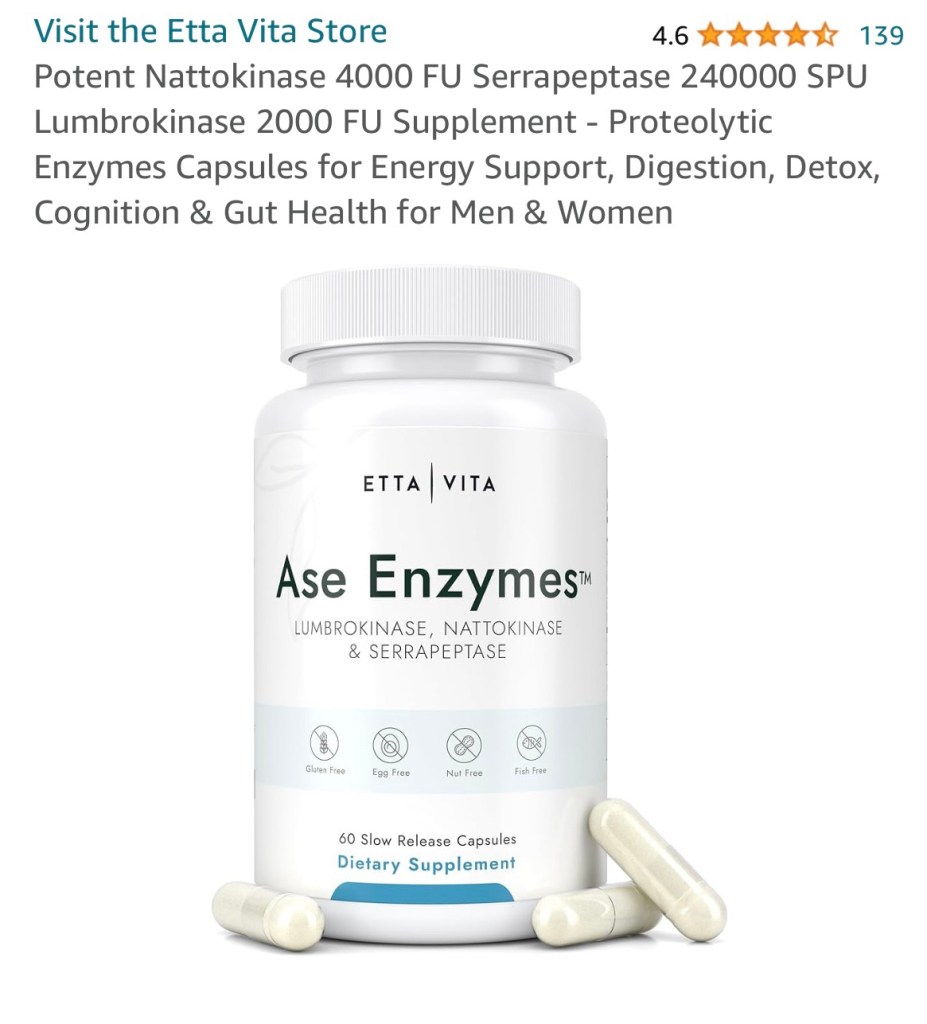
Nattokinase a serine protease enzyme which degrades spike glycoproteins
https://pubmed.ncbi.nlm.nih.gov/36080170/
Nattokinase (Bac s 1), a subtilisin family serine protease, is a novel allergen contained in the traditional Japanese fermented food natto – PubMed
https://pubmed.ncbi.nlm.nih.gov/36517353/
So Nattokinase should also degrade hemagglutinin a glycoprotein like the spike protein – both from RNA viruses . Available from Amazon ,Vitacost, or vitamin store.


 Effective Thinking